Malt, Cookies, and a Train Attack
We had broken the back of Lawrence's path to Aqaba, and waking up alongside one of the towering stone pillars of Wadi Rum was our reward.
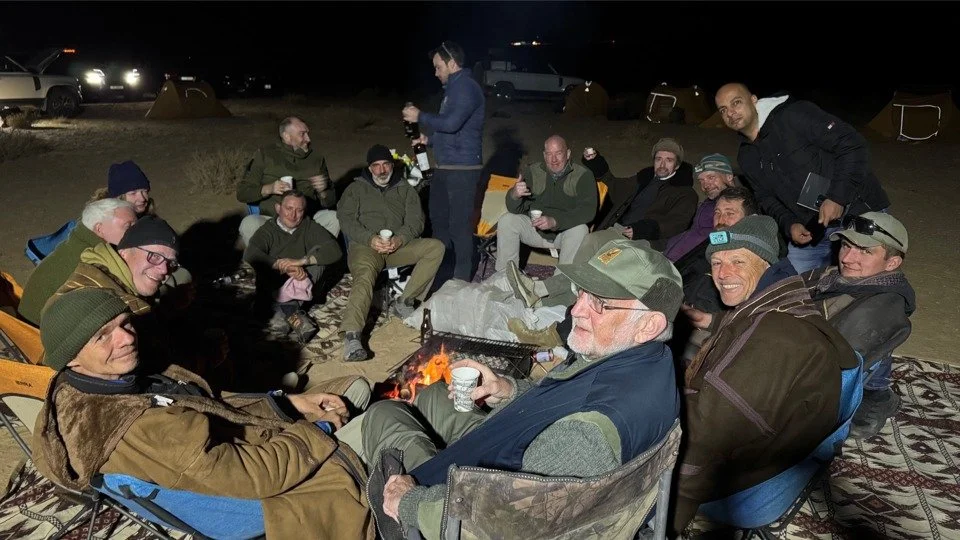
We'd only got about 40kms to ride on this day, and it would all be on flat, soft sand, which was kind to the riders and camels; everyone would be able to relax. However, from the rider's perspective, only one of us was as fresh as a daisy that morning. James hadn't had to get up at 0330, clear the campfire of "empties" and greet our fellow Club members via a video link at 8pm Washington DC time, 4am Jordan time. Hence, Tommo and I were a bit bleary-eyed through broken sleep. Neither had James over-indulged in the case of 25-year-old single malt that the Trek’s Benefactor, MM, had blessed the campfire group with the previous evening. The same could not be said for Craig, who emerged from his tent wishing the sun wasn't so bright that day, or that voices weren't so loud.
Because we had a lesser and easier distance that day, I'd made the decision to set off from Camp an hour later than we'd done before on the entire Trek. Also, we had a long-standing rendezvous to make that day, so the hour lag would help that work out too.
With Craig being a lot quieter than usual and clearly suffering from the movement of his camel, the rest of us laughed at his self-inflicted situation. What had been a Scotsman’s ball of fire the previous evening was indeed a heap of metaphorical ashes that morning. However, fortunately for all of us, morale was really high. We all knew that, except for any unexpected tragedy, we would make Aqaba, and I couldn't help but reflect on what Lawrence, Auda, Nesib and Sherif must have felt when they rode this same route out of Dabet Hanut. By now their numbers had swelled to 300 camels and horses consisting of the Auda Abu Tayi’s Howeitat and Nesib El Bekri's northern tribes. The original group of 45 had lost three men on the Trek, their swollen group of 300 would lose two more men on the charge into Aqaba. It was a remarkable military feat, but here we were, on our 23rd day and looking forward to seeing our families and taking a bath in Aqaba. Lawrence's team could only hope for the latter if they survived.
The ride into Wadi Rum is spectacular and lived up to everything the film Lawrence of Arabia had depicted. It felt such an honour to be there, but I reflected that we had truly earned it.
We held a good and steady walking pace. There was no reason to push the camels this day, and if we did trot, it was just to break the boredom of the walk. Additionally, thanks to the large rock formations, navigation was easy also today. I could literally take aim at a distant feature, and that would keep us bang on track. However, I was keeping a close eye on my watch.
The reason for this was that a month or so before the Trek, I'd had a call with the UK Ambassador to Jordan, Philip Hall, and his staff, including the Defence Attaché. Ambassador Hall had been hugely supportive throughout the entire planning for the Trek, and unbeknownst to us, he would be there to greet us in Aqaba. However, during one of the Zoom calls to the Embassy in Amman, we were joined by Rob Smith, a Company Commander in the Princess of Wales Royal Regiment (PWRR). He explained they would be exercising with the Jordanian Armed Forces at the time we entered Wadi Rum, and Rob asked if they could rendezvous with us in the desert. I'd told him, "Provided you bring a decent lunch!" He'd agreed, and we had picked out a Latitude and Longitude that would be about halfway along our route that day; that was our RV at 1300 local time.
Since that call, which seemed an age ago, we'd had no contact whatsoever, so as we came closer to the Lat and Long, which was positioned between two of Rum's pillars, I kept an eye on my watch to ensure we trotted in at 1300, and wondered if the British Army would show. Meanwhile, Rory had ranged forward in one of the Defenders to see if they could spot PWRR approaching. He reported on the radio, "nothing yet".
As 1300 approached, two other vehicles closed in on the position; one was one of our Defenders, the other an all-electric 4X4 lent to Richard Hammond by King Abdullah. (A very trusting thing to do given Richard's skill in wrecking vehicles;-)
As we trotted in and reached our vehicles, I was again told no sign of them yet. So, we dismounted and sipped some water while Royal Marine Tommo grumbled about Pongos always being late, just to be interrupted by someone saying, "Bugger me, here they come".
Four vehicles emerged from behind one of the large rock formations, which they clearly used as cover from view during their approach. Their vehicles kicked up dust as they closed the last few hundred metres, came to a halt and out jumped Maj Rob Smith, OC, A Company, 1st Battalion, The Princess of Wales Royal Regiment!
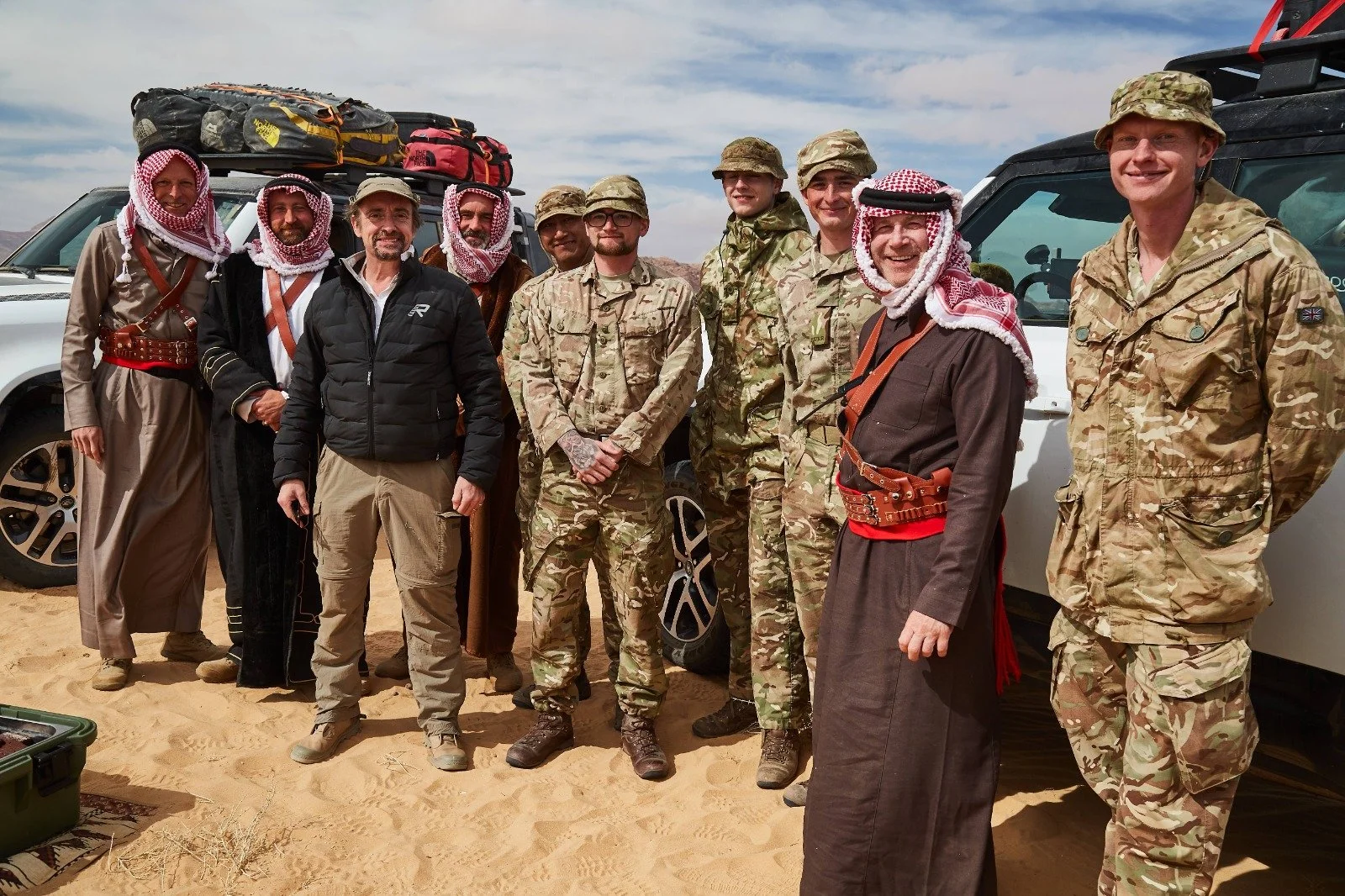
Our respective teams greeted each other, and both were pleased, even proud, that it had only needed one communication in the UK on 11 Dec 24 to set up an RV that was thousands of miles and weeks away. Rob's team was clearly pleasantly surprised to see Richard Hammond with us, and, to Richard's great credit, he spent the break-time taking selfies or giving the guys a ride in King Abdullah's wheels. Meanwhile, some of the PWRR team broke out the food: an excellent chicken curry with rice, followed by chocolate brownies. We laughed about not needing Simon’s fire-flavoured calories that night. Richard left a note for the chef, who wasn't there, explaining how much we'd enjoyed the food. We also gave each of the PWRR team a chance to ride our camels and led them in an extended circle to do that.
After about an hour, it was time to head on. We had about 15km to crack, and Tommo had decided that this should be a cigar event. So, we each smoked what were by now desert dried cigars to celebrate the fact that we had just two days to go.
By mid-afternoon, the Bedouin Police Commander had rejoined us on his “dressage camel”, and as we walked, he characteristically pulled ahead utilising his camel's prancing trot. He veered to the left of a prominent feature, which didn't seem right to me, but we decided to trust local judgment. However, after about half an hour, I was convinced he'd gone wrong, so I stopped my camel and did a bit of map study. To coin a phrase, "we were definitely taking the long way round".
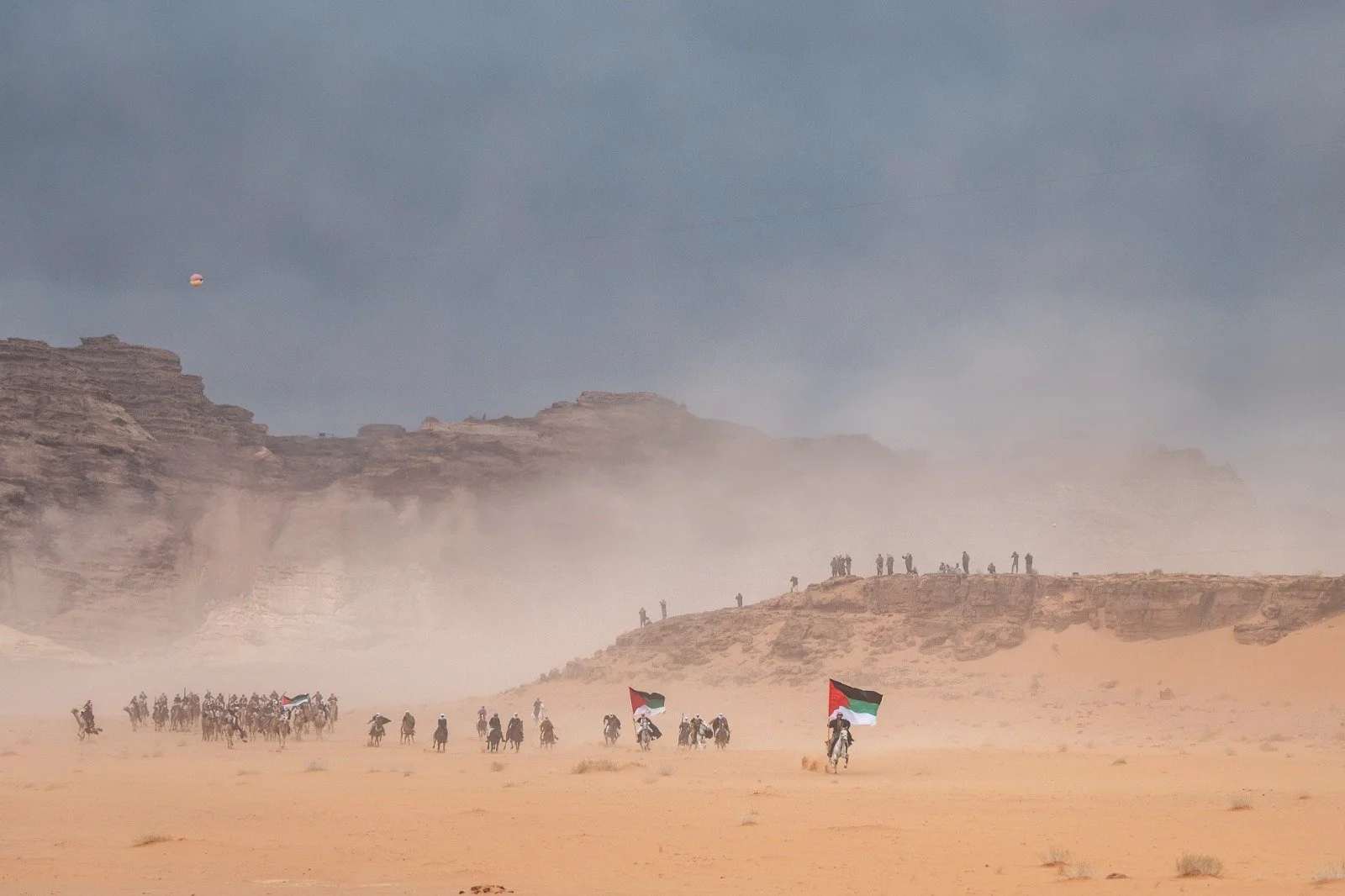
I decided we'd take the next re-entrant on the right, which narrowed then opened up into a small, flat plain. The weather was now noticeably and rapidly turning for the worse, clouds and strong winds whipping up the sand making a photogenic opportunity. Henry P. launched his drone and asked us to gallop, which was excellent, good for covering ground, and he probably achieved some of the most impressive drone footage that day.
As we emerged at the end of the plain, we turned right again, and I could see the Hejaz railway line, which would be our marker and guide into Camp.
Unbeknownst to the team, it had been arranged for us to re-enact an attack on the Hejaz Steam Train the following day. I hadn't said anything to the team in case it didn't come off, and that night it would be confirmed. Along with this the Jordanians had been very specific where we should camp. It was the only time they had, so when Rory came up and said they were relocating the Camp a kilometre or so closer to us, I asked him not to and not to set anything up until I arrived.
For whatever reason, Simon hadn't got the message, so the Camp was set up well short from where it should have been, and I knew the Jordanians wouldn't be happy because they'd specifically asked me to go to their chosen site to facilitate the train attack the next day, having even changed my original choice.
Needless to say, I was not at the top of a popularity contest when I told the guys, "Move the Camp”. However, I think when the reasons became obvious, then the team understood why I had to make that decision.
The Jordanians chosen Camp location was nestled into a concave rock feature that, although windward, actually buffered it from the wind. Further, there was also a singular big rock (known as “FBR”) that made an excellent kitchen shelter for Simon.
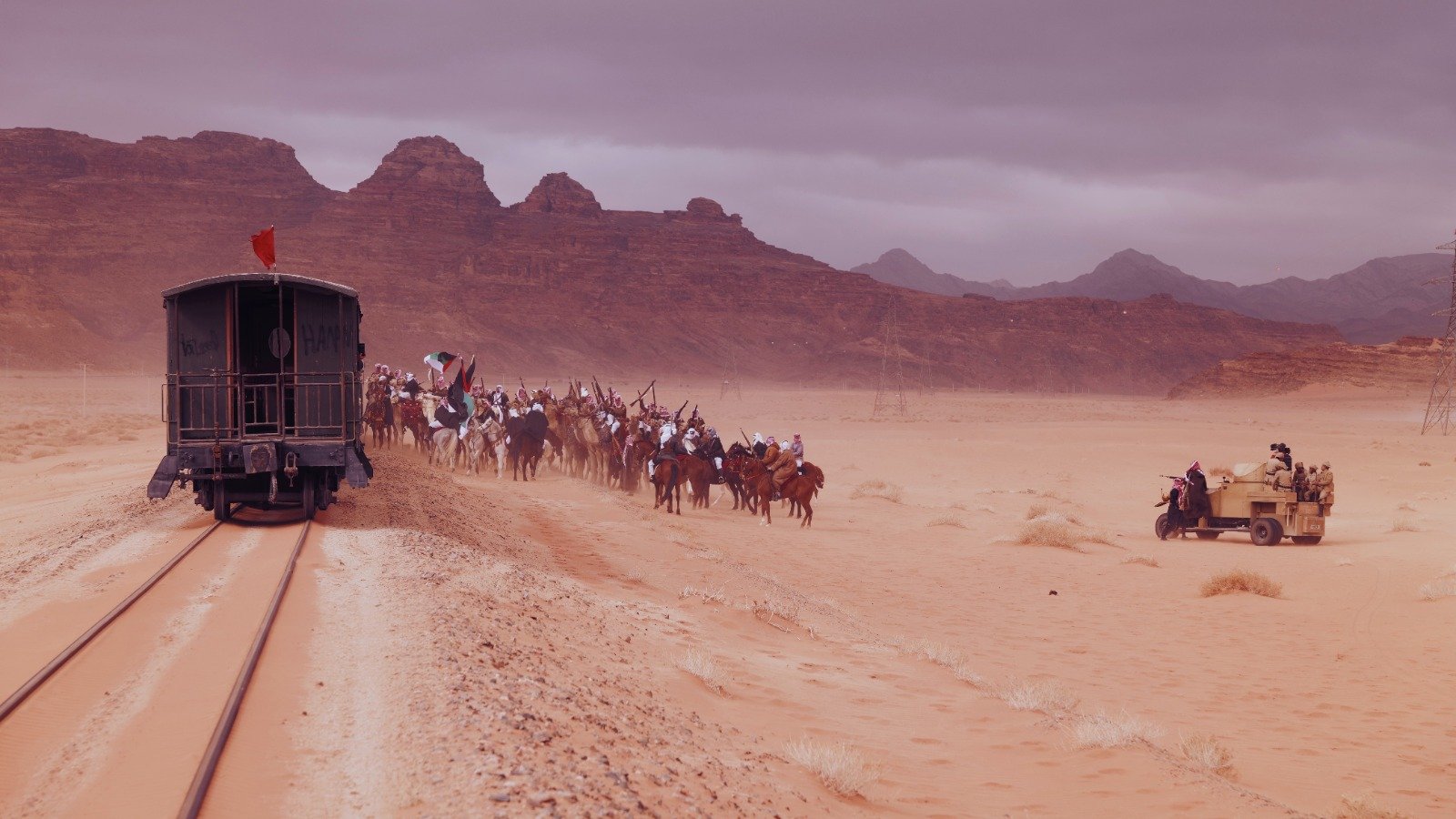
That evening, I explained to the team that the next morning, all the families who by now had arrived in Aqaba, would board the Hejaz Train thinking they were being brought to the Camp. However, we would be joined by 40 Arabian horses and 40 Bedouin Police camels to come out from our cover and attack the train. Henry jumped in to add, "Simulated", just in case anyone thought we were for real going to attack our families. I think he attracted the biggest and fondest laugh of the evening.
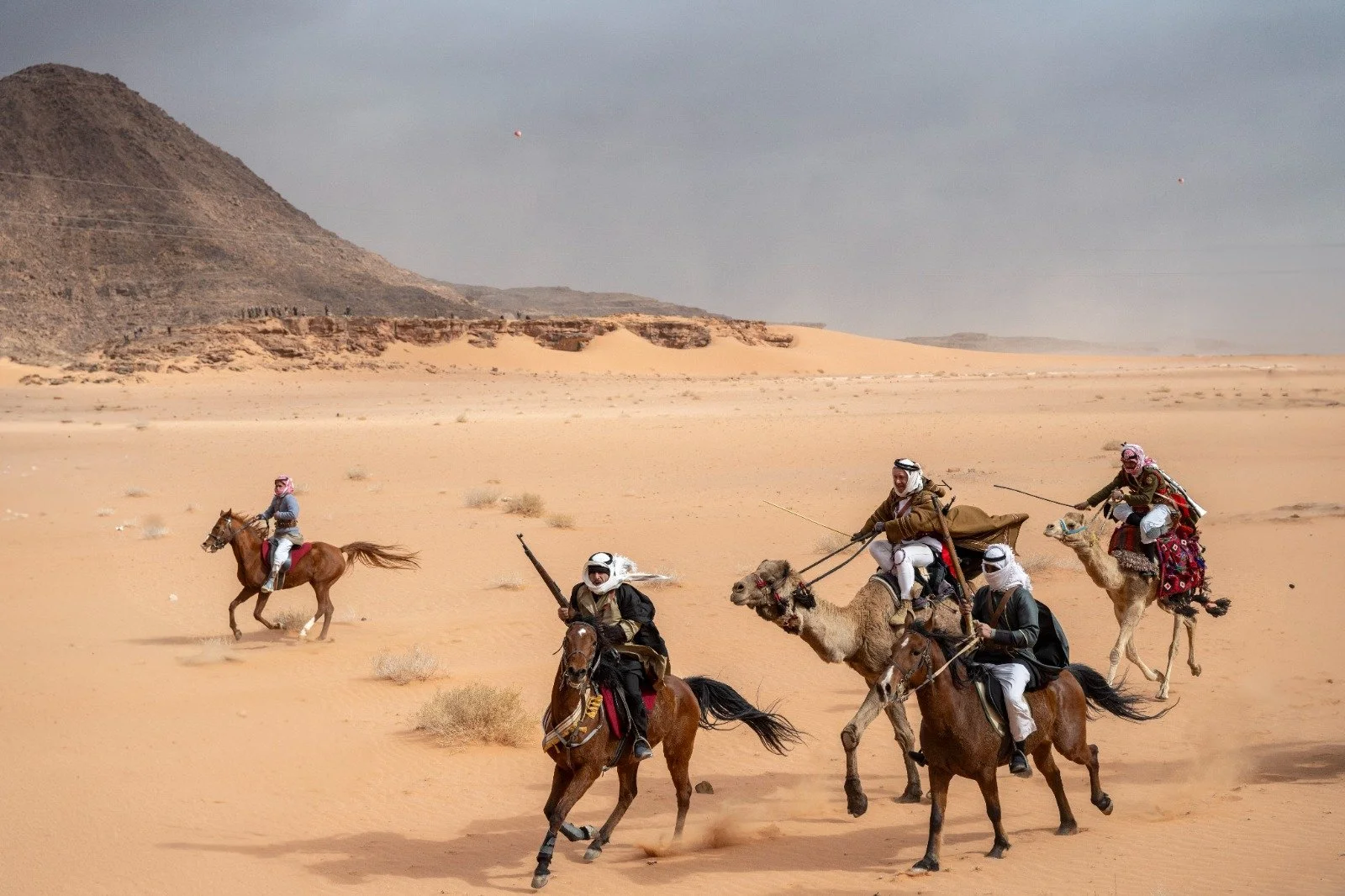
The next morning, the excitement was palpable and not just amongst the humans. At about 8am, the sound of Arabian horses and the grunts of camels were carried across the desert floor by the strong, almost freezing winds, which were also whipping up sand, creating the most eerie sense of expectancy and anticipation.
The 80 animals and riders were positioned behind a hill by employees of the Jordan Heritage Revival Company (JHRC), so that the entire force was hidden from view. At the same time, it awaited the sound of the steam train. The four SFC riders were issued with a rifle and ten blank rounds, with each rider figuring out how he'd secure the rifle to himself whilst galloping at full tilt to intercept the train. The Bedouin Police had no such problem; their camel rigs had huge saddlebags with rifle sheaths they could pull out and fire at will.
I eventually decided I would sling the rifle across my back and then, when closing in on the train, would slide it around to my front and into a firing position. Craig elected to sling his at the front, which would result in a cut lip by the end of the charge.
As we waited, the wind continued to pick up. The windchill was significant. The Bedouin Police used either rock formations or their camel to crouch in the lee and keep themselves warm. The SFC riders made good use of their Fawa coats, which kept the worst of the cold at bay. But the train was late.
We then learned that the sandstorm had caused "sand on the line", which was being cleared, hence the delay. As we waited, cold and huddled, I reflected that this must have been just what it was like for real, and that it was then a chilly hour, or even two, by the time we received the word that the train was coming!
In our hidden ground the horsemen came to the front of the group about to charge; they would cover the ground faster than the camels; they had speed over endurance. I nudged Shahan right to the front. I was determined to get him into an unimpeded gallop. The excitement by this stage was at fever pitch. The adrenalin was at toxic levels, this was the largest re-enactment ever carried out on the Hejaz Railway in modern times, and it was about to unleash.
One of the JHRC leaders was on a rock. He would be able to see the train, but we couldn't. We could, though, hear its whistle. The anticipation was palatable. He was shouting "Wait for my go; wait for my go". Then, all of a sudden, the train came into sight. The Arabian Horse rider alongside me, spurred his steed, and it launched towards the train, by now a few hundred yards away. I released Shahan's khatam (rein) and shouted "Hutt!". He knew what he needed to do and launched after the horse into an immediate gallop. This giant camel that Shahan was, galloped past the JHRC manager, and I heard him shout "Go" from behind. I didn't care, both camel and I were now at full tilt, and I was assessing my best intercept course to get alongside the train. I knew there were horses on each side of me and camels coming behind, but I just locked onto the train and concentrated on positioning Shahan so we could catch and gallop alongside it. Time stood still, so in what seemed like a moment, I was within metres of the train and working up from the rear coaches towards its front. I could clearly see the families of the trek members, so I was scanning for my wife and sister. Then I saw them; it was the first time I'd seen my wife in over a month. She was shouting; actually, screaming my name, and the undiluted excitement and emotion of all was clear to see.
As the train slowed, I pulled Shahan to a stop alongside the steam engine, then once it was static, turned him and walked him up to the train, which was now surrounded by the entire force, with gun (blanks) being fired in celebration. I came up to the carriage and manoeuvred him to say hello to my sister and her partner, and to kiss my wife. Shahan behaved perfectly; he was such a good camel.
The team and the families now combined in a celebration fuelled by adrenaline and emotion on both sides. Photographs and greetings continued for some time, including some stunning pictures of the wind-swept Wadi Rum and the train. It had been spectacular and a life-lasting memory for all concerned.
It was perhaps an hour later when the four riders and our three Bedouin police pals rode out, once again alone, along the Hejaz Railway towards our next Camp, our last Camp. The wind by now was howling, all of us had to grit our teeth, against the biting cold and the sand, which was getting everywhere.
We left the Hejaz railway behind us and turned south to enter the same riverbed that Lawrence used to enter Aqaba. By now he would have been moving at night to avoid detection; we could continue in daylight, much to the enjoyment of passers-by. After an hour or so, we stopped for some coffee, mainly to warm up; the windchill was well below freezing, but we knew that once we were in the steep-sided chasm, we should get some relief from the cutting wind, and we did.
During our break, we were joined by two young families from Amman’s British Embassy team. It was lovely to see their little daughters making a fuss of the camels with absolutely no fear of their immense size. I reflected that the animals somehow knew these were their equivalent of calves and thus reacted gently.
The riverbed was a really nice ride and without the wind some warmth got back into our bodies. I was just thankful it hadn't rained as we worked our way around the flood barriers and eventually started up the side of the valley to traverse to one of the catchment dams. At the top of the path, with about 3 km to go, we had to join the main road and head toward the security checkpoint into the Aqaba zone.
The Special Branch officers with us had cleared the way and the checkpoint staff looked on with bewildered amusement as they waved us through enabling our camels to enter the "free-city zone" of Aqaba.
Upon exiting the checkpoint, we re-entered the valley and crossed the dried riverbed towards an historic, anti-smuggling, Gendarmerie Fort, where, outside, they had carefully prepared a plateau with a marquee, a giant Majlis, and a barbecue. They'd even arranged a Portaloo and a fundamental portable shower. The welcome we received from the Gendarmerie was exceptional. They had clearly heard about the reception given to us by the Bedouin Police at Bayr Fort five days earlier and were determined to out-perform that.
Within minutes, the team's families began to arrive, having returned to their hotel in Aqaba by coach while we'd ridden the 35 km to the last Camp. What followed was a feast, Bedouin dancing, exchanges of gifts, and some thank-you speeches. At the far end of the Camp, the Trek's “washing-up team” seemed to have gathered, so I wandered over to discover not all the single malt had been devoured so I was grateful for a dram or two while we had a quick O-group for the final time. Tonight, we would sleep well. Tomorrow we would enter Aqaba, and unbeknown to us, what an entrance it would be.